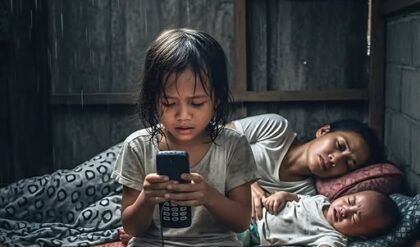
She was the girl everyone feared.
The girl no one wanted to touch.
The girl they called a witch because of a scar she never asked for.
But one ordinary morning, as she knelt by the roadside begging to save the only woman who had ever loved her, a billionaire stepped out of his car, took one look at her scar, and fell to his knees in tears.
What he revealed next would shake an entire village and rewrite her destiny forever.
Ojoko was the kind of village that looked peaceful from a distance. Clay houses. Dusty footpaths. Goats wandering lazily. Women pounding yam in courtyards. Smoke curling into the morning air.
But beneath that quiet surface lived fear, superstition, and cruelty.
And at the center of it all was Latifah.
She was nineteen, tall and slender, with gentle eyes and a jagged scar that ran from the left side of her forehead, curved across her eye, and ended at her cheek. A scar that should have been nothing more than a sign she had survived something terrible.
But in Ojoko, it became a curse.
Whenever Latifah stepped out of the small mud house she shared with Mama Zanab, people stared as though something unholy had passed.
“The witch is coming,” children shouted, running behind their mothers.
Some women spat on the ground.
Some men muttered prayers.
Others whispered stories that grew darker with every telling.
They said she was a demon child left behind by spirits.
They said she came from the forbidden river.
They said she killed her own family and wore the scar as punishment from the gods.
Latifah heard everything.
She felt every stare, every whispered insult, every cruel step backward when she passed. No one sat beside her. No girl her age fetched water with her. No one invited her to festivals, dances, or gatherings.
She had no friends.
No school would admit her.
No teacher wanted her in a classroom.
No one ever asked what she wanted to become.
In all her life, only one person had ever looked at her without fear.
Mama Zanab.
The old widow who had raised her.
Fraile in body, strong in spirit, Mama Zanab called her “my child” even when the whole village mocked her for it.
“She has bewitched that widow,” people said.
“How can a barren woman suddenly have a daughter?”
“Her husband died after the girl arrived. It must be the child.”
Still, Mama Zanab never wavered.
Even when villagers refused to buy her roasted plantain.
Even when people stopped bringing their laundry to her.
Even when hunger followed them into the house.
She still cooked whatever little they had with love.
Sometimes only garri and water.
Sometimes boiled yam with pepper.
Still she smiled at Latifah every morning.
Still she prayed over her scar, not because she believed it was evil, but because she wanted her daughter to feel whole.
But Latifah never felt whole.
Whenever she looked into the cracked mirror hanging near their doorway, the scar seemed to look back at her like a wound with a story no one would tell. She often traced it with her fingers and imagined another life—one where she was beautiful, accepted, normal.
Yet her whole world was Mama Zanab.
And Mama Zanab’s whole world was her.
One cool evening, as the sky turned orange and the village settled into the softness before night, Mama Zanab finally told her the truth.
Latifah had been grinding pepper when the old woman called her to sit down.
“My daughter,” Mama Zanab began, her voice trembling, “you have carried questions for too long. It is time you know how you came into my life.”
Latifah’s heart began to race.
Seventeen years earlier, a terrible storm had torn through the land. Rain lashed the trees, thunder shook the earth, and lightning split the sky like fire. Mama Zanab had been waiting for her husband to return from the next village when she heard it—a terrible crash somewhere along the road.
She grabbed a lantern and ran into the storm.
At a sharp bend near the old iroko tree, she found a bus overturned in a ditch, smoke rising from the engine, glass everywhere, bodies scattered in the mud.
Everyone was dead.
Or so she thought.
Then she saw movement.
A tiny child, no more than two years old, soaked with rain and blood, lying beside a broken seat. The little girl’s fingers trembled weakly. Her face was badly cut. That was the night Latifah’s scar was born.
Mama Zanab carried her through the storm and waited for someone to come looking.
No one did.
By morning, she understood that the child had been placed in her life for a reason.
Her husband returned the next day, and together they chose to raise the girl as their own.
“But when the village found out you were the only one who survived,” Mama Zanab whispered, “they decided you could not be human.”
Soon after, her husband fell ill and died.
That was all the villagers needed.
They blamed Latifah.
They blamed the scar.
They blamed the child.
“But I never regretted saving you,” Mama Zanab said, tears in her eyes. “Not once.”
Latifah broke down crying and laid her head in the old woman’s lap.
For the first time, the scar meant something more than shame.
It meant survival.
It meant love.
It meant that someone had chosen her when everyone else would have walked away.
But life in Ojoko did not change.
The whispers continued.
The hatred remained.
And then Mama Zanab grew sick.
At first it was a cough.
Then weakness.
Then pain in her chest.
Soon she could barely rise from her mat.
Latifah watched in horror as the only person who had ever loved her began to fade. She begged Mama Zanab to let her fetch the herbalist, but the old woman only smiled weakly.
“They won’t help me,” she said. “Not the woman who raised the witch child.”
Latifah tried everything she could. She cooked pepper soup. She sat beside her all night. She prayed until her throat ached. But Mama Zanab’s breathing grew weaker, her eyes dimmer.
Then one morning, when the old woman could no longer sit up at all, Latifah made a decision.
She would beg.
Not in Ojoko, where they would only spit at her.
But in the market town nearby, where strangers might show mercy.
She wrapped Mama Zanab carefully, left water beside her, kissed her forehead, and walked miles under the sun until she reached the busy roadside market.
There she sat with a cracked calabash in front of her.
“Please help me,” she whispered to every passerby. “My mother is dying. Please, anything.”
Most people ignored her.
Some stared at her scar and walked away.
Some frowned, suspicious.
Still she stayed.
Minutes stretched into hours.
Not far from the market, a convoy of black SUVs moved slowly through traffic.
Inside the lead car sat Chief Karim Adeni, one of the richest men in the region. A billionaire industrialist. A man known for power, wealth, and influence.
But beneath the polished suits and public reputation lived a father whose heart had never healed.
Seventeen years earlier, that same storm had taken his wife and his little daughter.
He had been told the bus crashed, that no one survived, that the fire and rain had destroyed everything. His daughter’s body was never found, but over time he had been forced to accept what everyone insisted was true.
She was gone.
Still, he never forgot the last thing he saw that night.
Blood on his little girl’s face.
A deep cut on the left side.
A scar beginning to form.
As the convoy slowed near the market, Chief Karim looked out absently—and froze.
A girl was sitting by the roadside, begging.
Her face was turned slightly toward the light.
And there it was.
That scar.
That exact scar.
His breath caught.
“Stop the car,” he said.
His driver hesitated. “Sir, we’re already late.”
“I said stop.”
The convoy halted.
Chief Karim stepped out slowly, barely hearing the gasps around him. He moved toward the girl as if pulled by something stronger than reason.
Latifah looked up only when his shadow fell across her.
Their eyes met.
And the world changed.
Chief Karim stared at the scar, and all the years he had spent burying grief came crashing down at once. He staggered backward, one hand pressing against his chest.
Latifah panicked.
“Sir, I’m sorry,” she said quickly. “Please, I didn’t mean to frighten you.”
He stepped closer again, tears already gathering in his eyes.
“Your face,” he whispered. “That scar—how did you get it?”
Latifah blinked, confused. No one had ever asked gently before.
“I don’t know,” she said softly. “My mother said she found me after an accident.”
The words hit him like lightning.
“An accident?”
She nodded. “She found me as a child. In a crash.”
He could hardly breathe.
“Your mother,” he asked, voice shaking. “Who is she? Where is she?”
“She is very sick,” Latifah said, shame filling her voice. “That is why I came here to beg.”
Something inside him broke.
Right there on the dusty roadside, in front of traders and hawkers and stunned strangers, Chief Karim Adeni dropped to his knees.
The market went silent.
He looked up at her with tears running openly down his face.
“My daughter had a scar like this,” he whispered. “She was only two when the accident happened.”
Latifah’s hands trembled.
“Do… do you know me?” she asked.
His lips quivered. “I might.”
Then, with the tenderness of a man touching a miracle, he reached out and gently touched her scar.
“Please,” he said. “Take me to your mother.”
Latifah hesitated, terrified and hopeful at the same time.
“She is very ill. And our home… it is not a place for someone like you.”
He shook his head firmly. “If there is even a chance that you are who I think you are, I must go.”
Latifah searched his face and saw no disgust there.
Only pain.
Only hope.
Only longing.
So she nodded.
“I will take you.”
He opened the SUV door for her, and for the first time in her life, Latifah stepped into luxury.
As the convoy drove toward Ojoko, Chief Karim sat beside her in silence, staring at her face as though afraid she might disappear.
In his heart, one prayer repeated over and over.
Let her be mine.
Back in the village, the convoy caused chaos.
Villagers poured from their homes at the sight of expensive cars rolling across the dusty road. Whispers spread like fire.
“Why is the witch child with rich men?”
“What has happened?”
“What trouble is this?”
Latifah led them to the little mud house and rushed inside.
“Mama! Mama, I’m home.”
Mama Zanab opened her eyes weakly. When she saw the man behind Latifah, she tried to sit up.
“Who is that?”
Latifah knelt beside her. “Mama, he wants to help us.”
Chief Karim stepped forward respectfully.
“My name is Karim Adeni,” he said gently. “I came because of the girl you raised.”
The old woman’s eyes softened instantly.
“My daughter,” she whispered.
He knelt beside her. “Please tell me how you found her.”
And once more, Mama Zanab told the story of the storm, the crashed bus, the bodies, the toddler still breathing.
When she finished, Chief Karim was weeping openly.
“That same night,” he whispered, “I lost my wife. And my daughter disappeared.”
Latifah gasped.
He leaned closer. “Did you keep anything? Anything she wore?”
Mama Zanab pointed weakly to a small wooden box beneath her mat.
Inside it, wrapped carefully in cloth, were the burnt remains of a tiny pink dress and a small gold anklet engraved with the letter Z.
Chief Karim froze.
He recognized it instantly.
His wife had commissioned that anklet herself.
The Z stood for Zanab—their daughter’s birth name.
He clutched it in shaking hands and cried.
“It’s hers,” he whispered. “This belonged to my little girl.”
Latifah sat in stunned silence as the room seemed to tilt around her.
Could it be true?
Could this man really be her father?
At last he looked at her with tears still on his face.
“My heart tells me you are mine,” he said softly. “But to protect your future, to remove every doubt, we must do one thing more. We must confirm it.”
“A DNA test?” Latifah asked.
He nodded.
Mama Zanab squeezed her hand. “My child, if this is your father, the truth must stand in the light.”
Latifah swallowed hard and nodded. “Yes.”
The next morning, a helicopter landed outside Ojoko.
The villagers nearly lost their minds.
Some fell to their knees.
Some ran.
Some whispered that spirits had come for the witch child.
Latifah helped Mama Zanab into the aircraft while Chief Karim’s security team formed a protective circle around them.
Within hours they were in a city hospital far beyond anything Latifah had ever imagined.
Doctors treated Mama Zanab immediately.
The DNA samples were taken.
And then came the waiting.
Chief Karim paced endlessly.
Latifah clasped her hands together and prayed.
Finally, a doctor appeared with an envelope.
Chief Karim opened it with shaking fingers.
His eyes moved across the page.
Then he cried out.
Not in pain.
In joy.
He turned and pulled Latifah into his arms, holding her so tightly she could feel his whole body shaking.
“It’s you,” he sobbed. “You are my daughter. My blood. My little star. You lived.”
Latifah broke into tears in his embrace.
“Father,” she whispered.
It was the first time she had ever spoken the word.
Mama Zanab, now sitting in a wheelchair nearby, covered her mouth and wept.
The doctor smiled softly. “It is a 99.9 percent match. She is your biological daughter.”
Seventeen lost years had ended in a hospital corridor.
Chief Karim knelt before Mama Zanab and took her hands.
“You saved my child,” he said. “I owe you everything.”
He refused to let either of them return to Ojoko.
Mama Zanab would receive the best care.
Latifah would never beg again.
Three days later, once the old woman was stable, a limousine arrived to take them to Chief Karim’s home.
Latifah could barely believe what she was seeing.
A massive gate.
A mansion with fountains and flower gardens.
Marble steps.
White pillars.
Balconies lined with doves.
“This cannot be real,” she whispered.
Chief Karim smiled through tears.
“Welcome home.”
Inside, the house was even more overwhelming—gold chandeliers, polished floors, paintings, grand staircases, rooms larger than their entire hut in Ojoko.
Mama Zanab touched the bed in her new room with trembling fingers and whispered, “Allah is merciful.”
That evening, Chief Karim gathered them in the living room.
“I lost seventeen years of your life,” he said to Latifah. “No wealth can return those years. But I promise you this—your future will never resemble your past.”
He promised education.
Safety.
Travel.
Choice.
Dignity.
Then he turned to Mama Zanab.
“You protected my daughter when the world rejected her. You will never lack anything for the rest of your life.”
The old widow cried and bowed her head.
“I only did what any mother would do.”
“No,” he said gently. “You did what only a brave mother could do.”
In the weeks that followed, Latifah began treatment for the scar. Specialists softened the tissue and healed the lingering pain.
But when one doctor suggested removing it entirely, she shook her head.
“No,” she said. “Do not erase it. It is part of my story.”
Meanwhile, the news reached Ojoko.
The same villagers who had called her a witch now changed their tune.
“We always knew she was special.”
“Did we not say destiny followed her?”
But Latifah did not return to them in anger.
She had outgrown their cruelty.
One evening, she stood on the balcony of the mansion beside Chief Karim as the sky glowed orange.
He looked at her with gratitude and wonder.
“My daughter.”
She smiled softly.
“Yes, Father.”
It was the first time she said it without fear.
He opened his arms.
She stepped into them.
And behind them, Mama Zanab watched from the doorway, tears flowing quietly down her cheeks.
The girl who had been mocked, rejected, and called cursed had become the daughter of a billionaire.
The scar that once brought her shame had become the very mark that led her back to her true family.
And in the end, it was not beauty, wealth, or status that saved her.
It was love.
The love of a poor widow who chose mercy over fear.
The love of a father who never stopped grieving.
The love of destiny, which waited patiently until the right moment to bring the lost home again.
And so the girl everyone feared became the girl everyone remembered.
Not as a witch.
But as a miracle.
News

Isang linggo bago ang kasal, sinabi sa akin ni Cody na ipahiram ko ang aking wedding gown sa kanyang “Great Love” o First Love.
Isang linggo bago ang kasal, sinabi sa akin ni Cody na ipahiram ko ang aking wedding gown sa kanyang “Great Love” o First Love. “Unang beses na lalakad si Lianne sa red carpet pagkauwi niya ng Pilipinas, kailangang maging napakaganda niya. Pagkatapos ng event, ibabalik…

BIGLA AKONG S!NAMP4L NG GF KO NANG MAGISING SIYA ISANG UMAGA HABANG MAGKATABI KAMI SA KAMA. SABI NIYA MAY BABAE DAW AKO SA PANAGINIP NIYA. AT ANG MGA PANAGINIP DAW MGA SIGNS DAW YUN AT IBIG SABIHIN DAW AY TOTOO YUN, KAYA IYAK NA SIYA NG IYAK DAHIL MERON DAW AKONG BABAE KAHIT SABI KO WALA
BIGLA AKONG S!NAMP4L NG GF KO NANG MAGISING SIYA ISANG UMAGA HABANG MAGKATABI KAMI SA KAMA. SABI NIYA MAY BABAE DAW AKO SA PANAGINIP NIYA. AT ANG MGA PANAGINIP DAW MGA SIGNS DAW YUN AT IBIG SABIHIN DAW AY TOTOO…
INIWAN KO SILA SA HAPAG-KAINAN DAHIL SA BASTOS NA JOKE NI TITO
INIWAN KO SILA SA HAPAG-KAINAN DAHIL SA BASTOS NA JOKE NI TITOMinsan talaga, kung sino pa ang kadugo mo, sila pa ang unang tumatama sa pride mo.Nagtipon-tipon ang buong pamilya para sa isang masayang reunion—yung tipong maraming pagkain sa mesa,…

PINALAYAS KO ANG SIL(Sister-in-Law) KO SA BAHAY NAMIN DAHIL HINDI SIYA TUMUTULONG SA GAWAING BAHAY
PINALAYAS KO ANG SIL(Sister-in-Law) KO SA BAHAY NAMIN DAHIL HINDI SIYA TUMUTULONG SA GAWAING BAHAYMay mga pagkakataon talaga na kahit gaano ka kapasensyoso, darating ang punto na mapupuno ka rin.Lalo na kapag ang isang tao ay nakikitira na nga lang…
HINDI AKO FREE-TAKER NG ANAK NG IBA KAYA KAHIT NAKATUNGANGA LANG AKO SA BAHAY AYAW KONG MAG-ALAGA NG PAMANGKIN
HINDI AKO FREE-TAKER NG ANAK NG IBA KAYA KAHIT NAKATUNGANGA LANG AKO SA BAHAY AYAW KONG MAG-ALAGA NG PAMANGKINMinsan, ang hirap kapag ang tingin ng pamilya mo sa “rest day” mo ay “extra time” para sa kanila.Akala nila dahil wala…

BIGLA NA LANG NASA SALA NAMIN ANG KAPITBAHAY NAMIN—KAYA NAPABILI AKO NG DOBERMAN PARA MATUTO SIYANG KUMATOK
BIGLA NA LANG NASA SALA NAMIN ANG KAPITBAHAY NAMIN—KAYA NAPABILI AKO NG DOBERMAN PARA MATUTO SIYANG KUMATOKMay mga kapitbahay talagang parang may invisible pass sa bahay mo kahit wala naman talaga.Tawagin niyo na lang akong Lena.Tahimik lang sana ang buhay…
End of content
No more pages to load